
Most kitchens estimate their waste. A waste audit measures it. Before recommending any system, RUR can conduct a structured audit of exactly what your kitchen generates, how much, and where it currently goes.
A waste audit is a short, structured exercise, not an ongoing commitment.
Identifying every point in your kitchen where waste is generated.
Weighing wet and dry waste over a representative period, not a guess.
What you currently pay, to whom, and how often.
Where mixed waste is currently slipping through.
Clear findings and recommendations you can act on, or take to a budget meeting.
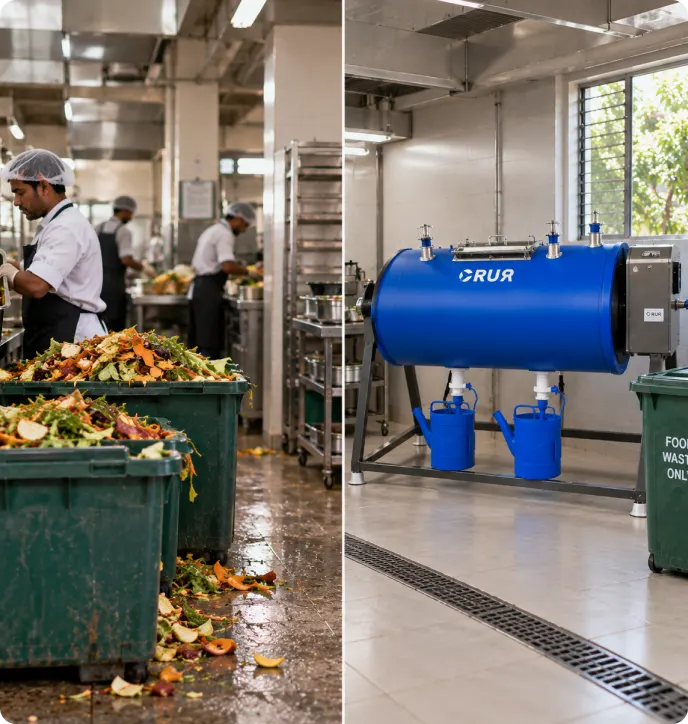
A composting system sized on a guess is either too small, which means it falls behind within weeks, or too large, which means you have paid for capacity you do not use. A waste audit removes the guesswork. It gives you an exact daily volume, broken down by source, which is the single number every other decision, system size, compliance position, ROI calculation, depends on getting right.
If you are not sure how much waste your kitchen actually generates, or where it currently goes, a waste audit is the clearest place to start. It costs nothing to enquire, and the findings are yours to use whether or not you go further with RUR.
A waste audit is a structured, precise measurement of a kitchen’s actual waste generation, covering waste stream mapping, volume measurement over a representative period, a review of current disposal arrangements and costs, and a written report with findings. It differs from a broader KWAN assessment in its focus on precise measurement rather than general guidance. A KWAN assessment covers the full picture, including segregation training and system recommendations, while a waste audit is specifically about establishing an accurate, defensible waste volume figure that other decisions can then be built on.
A composting system sized on an estimated waste volume is often either too small, meaning it falls behind the kitchen’s real output within weeks, or too large, meaning the kitchen has paid for capacity it does not need. A waste audit replaces that estimate with a measured, accurate daily volume figure, broken down by source. This number is the foundation for choosing the right system size, calculating an accurate return on investment, and confirming a kitchen’s compliance position under the Solid Waste Management Rules 2026.
A waste audit typically involves measuring a kitchen’s waste over a representative period, long enough to capture normal variation between weekdays, weekends, and any predictable peaks, alongside a review of current disposal arrangements. The exact duration depends on the kitchen’s operating pattern, and RUR agrees the specifics with each client before beginning. The output is a written report with clear findings, delivered promptly once the measurement period is complete.
No. A waste audit is a standalone service that gives you an accurate picture of your kitchen’s waste, which you are free to use however you choose, whether that means proceeding with RUR, exploring other options, or simply having the data on file for internal reporting or compliance purposes. There is no obligation to install anything as a result of the audit.
