
Residential societies, schools and colleges, industrial canteens, hotels, hospitals and religious institutions generate organic waste every day.
Residential societies, schools and colleges, industrial canteens, hotels, hospitals and religious institutions generate organic waste every day.
RUR’s community-scale composting solutions help process that waste where it is generated—matched to your waste volume, available space and everyday operating realities.
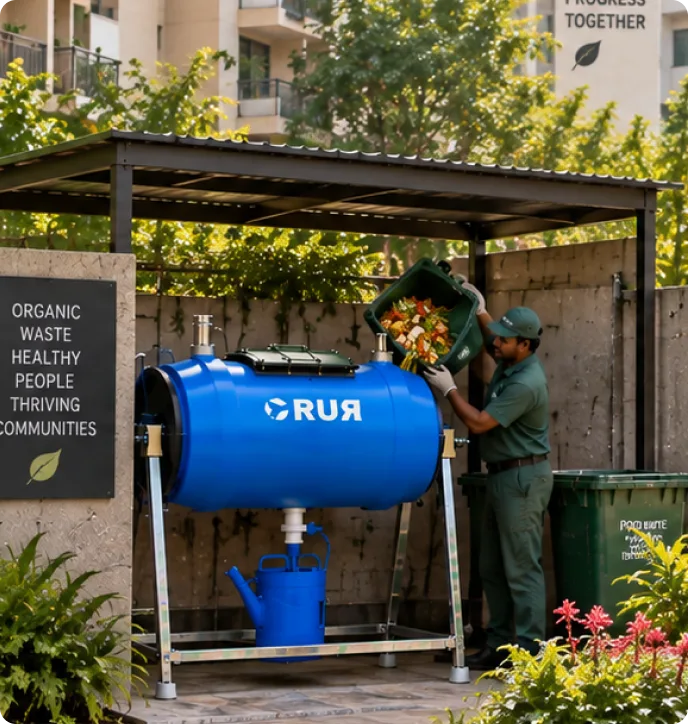
When organic waste is processed where it is generated, your community can reduce what needs to be transported away and turn food waste into something useful.
The same natural composting process can work across different community and institutional settings. What changes is the scale, the space and the way the system needs to fit into everyday operations.
Process organic waste on-site instead of sending it away with mixed waste.
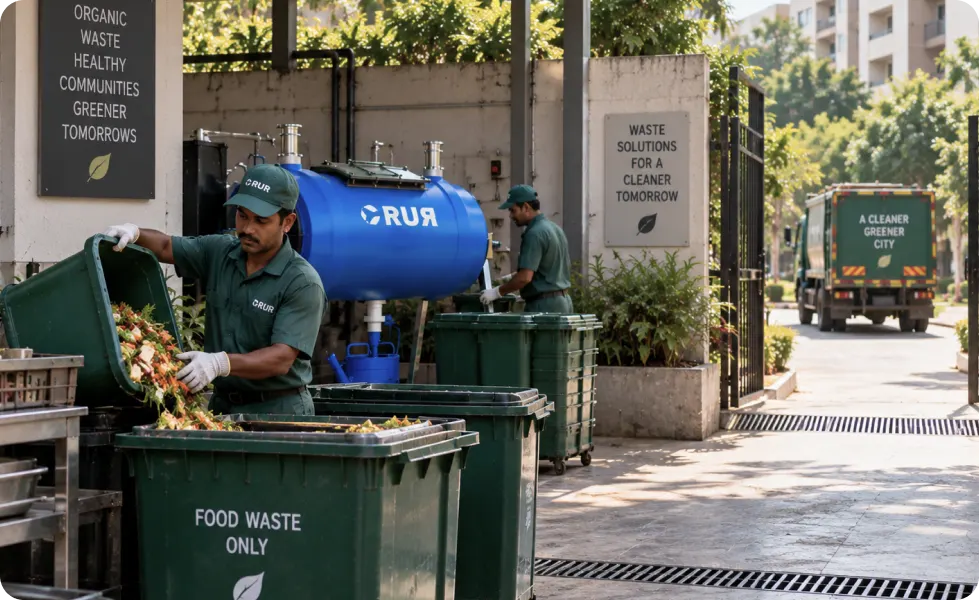
Turn kitchen and food waste into usable compost for gardens and green spaces.
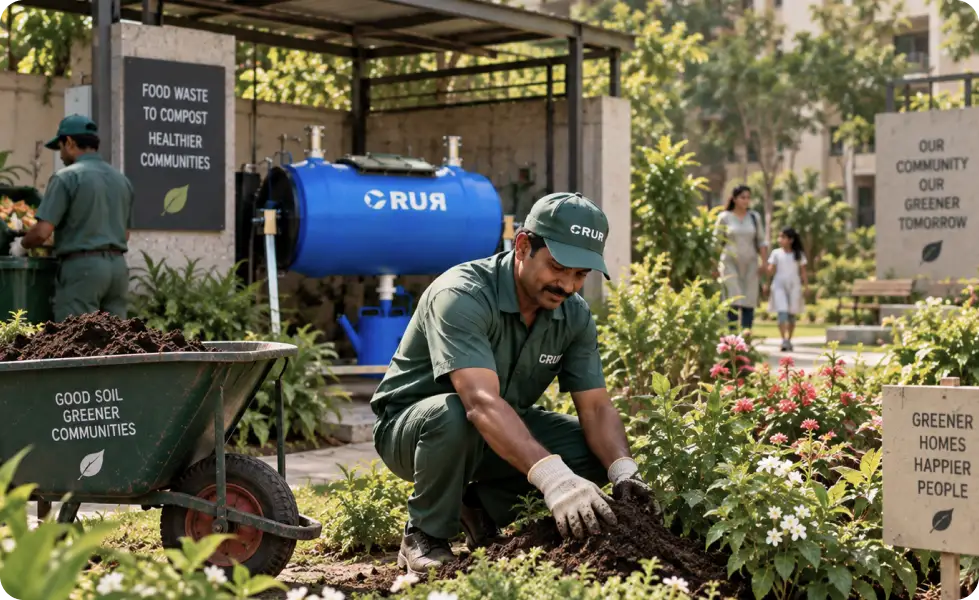
Give residents, students, staff and visitors a tangible way to see what responsible waste management looks like.
Match the composting setup to your actual waste volume, available space and operating requirements.
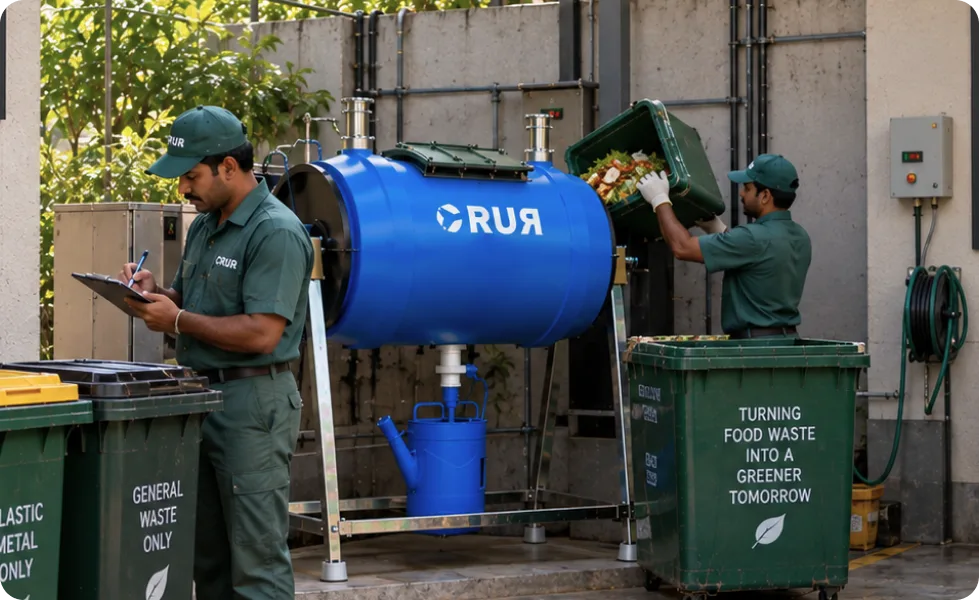
Process organic waste on-site instead of sending it away with mixed waste.
Turn kitchen and food waste into usable compost for gardens and green spaces.
Give residents, students, staff and visitors a tangible way to see what responsible waste management looks like.
Match the composting setup to your actual waste volume, available space and operating requirements.
1//4
The right composting solution depends on who you are, how much waste you generate and what you need the system to achieve.
Community composting lets a building or society manage its organic waste right where it is generated, turning food scraps and garden trimmings from many homes into compost for shared gardens. Gardens turn visibly greener, the composting area stays odour-free, and many residents notice birds returning to spaces that had gone quiet. In several states, on-site composting is now a direct compliance requirement for residential premises, and in Mumbai it can also mean a property tax rebate of up to 15% from the BMC.
Minimal effort, near-zero running cost.
Rich, lab-certified compost that goes straight back into your own green spaces.
From a single building to a full township setup.

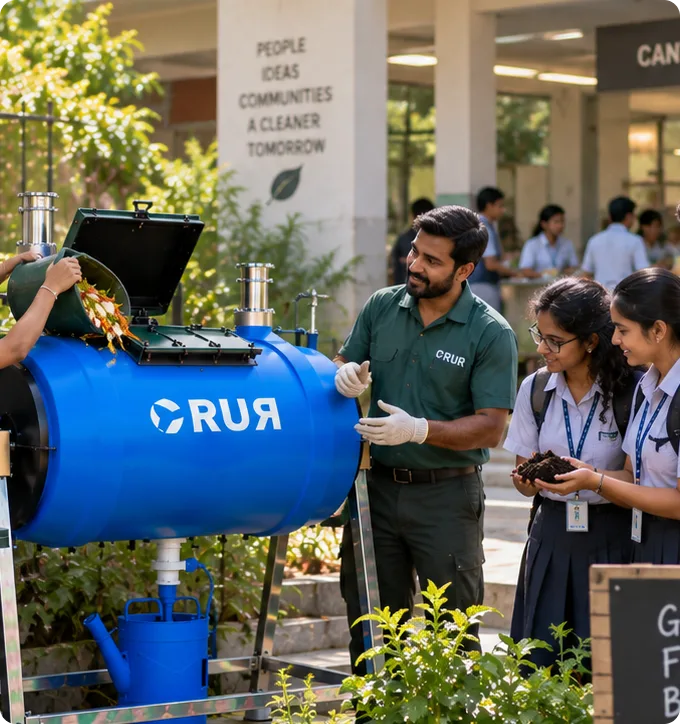
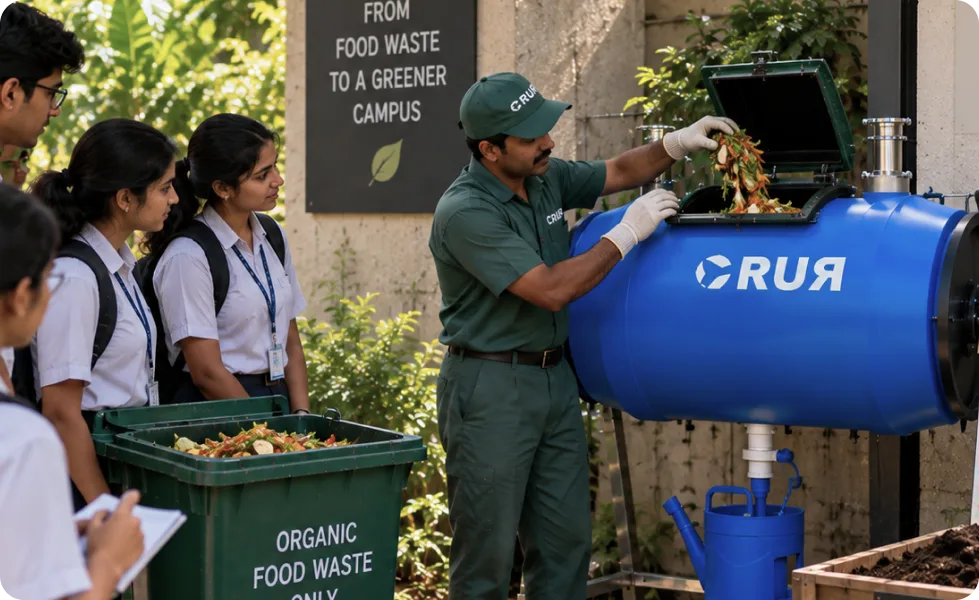
A school or college canteen runs on a fixed menu and a known headcount, so the waste it produces is remarkably consistent day to day. That predictability makes the return on a composting system easy to calculate. It also turns the composter into a live teaching tool, letting students watch their own lunch waste become the compost that feeds the campus garden.
Steady daily volume, a clean payback calculation.
Students see canteen waste become compost, without a single classroom slide.
A direct route to meeting source-segregation rules for institutions.
A factory or corporate canteen runs on fixed shifts and a known headcount, which makes its food waste more consistent than almost any other kind of kitchen. That regularity gives you the cleanest payback calculation of any sector, and it maps directly onto ESG reporting through UN Sustainable Development Goals 12, 13, 11, and 3, covering responsible consumption, climate action, sustainable communities, and health and well-being.
Consistent volume, a predictable return, easy to defend to finance.
A fully traceable, on-site process.
Clean, sealed, on-site handling that stands up to inspection.

Tell us about your property, your waste and what you’re trying to achieve. We’ll help you understand the most practical way forward.
Resort Composters is built specifically for resort properties, with content focused on seasonal guest volumes, guest experience, and resort-specific compliance. Community Composters covers four related but distinct audiences under one page: residential societies, schools and colleges, industrial canteens, and hotels, hospitals, and religious institutions. These groups share a community or institutional character rather than a resort holiday experience, so their composting needs, whether hygiene standards for a hospital or shared garden benefits for a housing society, are addressed separately within this page.
Yes. RUR’s community-scale composters are modular, so a residential society, school, or campus can start with a single unit and add more as needed, or install multiple units sized to the property’s total daily waste volume. During an enquiry, RUR reviews the number of residents, students, or staff, the estimated daily waste, and the available space, then recommends a configuration matched to the property’s actual needs rather than a one-size-fits-all machine.
They share the same core system but different priorities. A hospital typically prioritises hygienic, clearly documented waste handling that supports internal health and safety standards. A religious institution such as a temple, ashram, or gurdwara often already has a strong practice of not wasting food from community meals, and composting extends that ethic in a visible, practical way. A hotel’s priority is usually closer to a resort’s, reducing disposal costs and supporting a sustainability story, but without the seasonal guest framing a resort needs. RUR tailors the assessment and recommendation to which of these priorities matters most for a given property.
In an increasing number of states, yes. The Solid Waste Management Rules 2026 place responsibility for segregation and responsible wet waste handling on residential premises that generate significant daily waste, which includes most housing societies above a certain size. Some municipal bodies go further with direct incentives. Mumbai’s BMC, for example, offers a property tax rebate of up to 15% to housing societies that process their wet waste on site. Composting on site is the most direct way for a society to meet its obligations and, in cities offering a rebate, reduce its tax bill at the same time.
School and college composting meets two goals at once. On compliance, the Solid Waste Management Rules 2026 require many educational campuses to segregate and process organic waste at source, and an on-site composter does this directly. On sustainability and teaching, a working composting system lets students see the full cycle from canteen waste to finished compost to a growing plant, which is a far more effective way to build environmental awareness than a classroom lesson alone. RUR’s Meal-to-Soil programme, part of our CSR services, is built specifically to combine both of these outcomes for schools.
