Compliance concern
We map where your kitchen stands against the current waste rules, in plain language.
Most composting decisions fail long before the composter arrives.
KWAN gives you the knowledge and guidance to understand your waste, navigate the rules, calculate the numbers and plan the right approach before you invest.
Good composting starts with knowing what you’re dealing with. Explore the fundamentals of kitchen waste, composting and segregation before choosing a system.
Kitchen waste is any organic material generated during food preparation and service. Getting the basics right is what makes every later decision, from segregation to composting to compliance, straightforward instead of confusing.
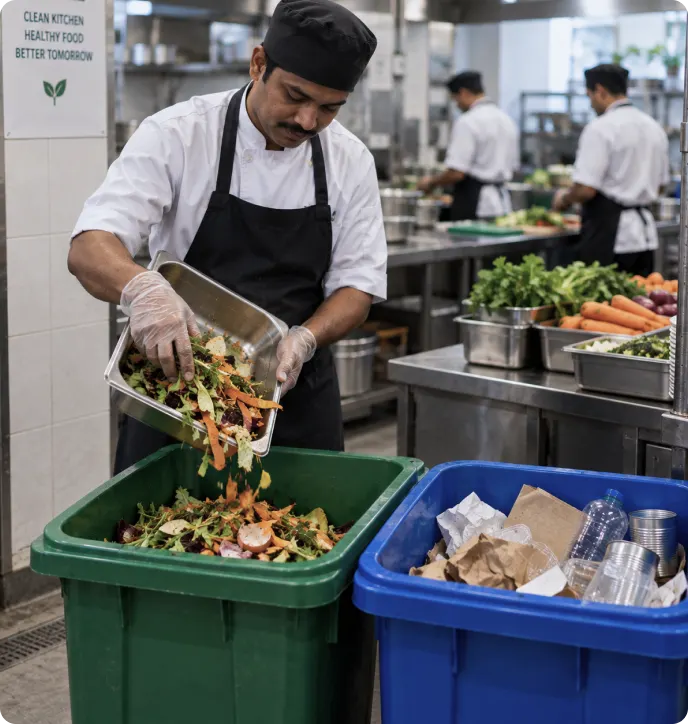
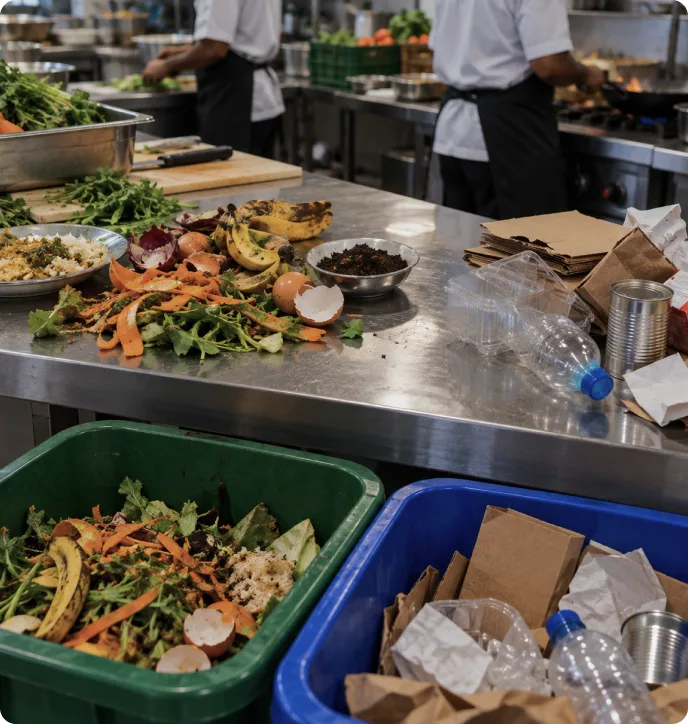
Vegetable peels, fruit scraps, cooked food, tea leaves, eggshells. This is what a composter processes.
Packaging, plastic, glass, metal, paper. Kept separate from wet waste and handled through recycling.
The single most important number for planning. Measured in kilograms of wet waste per day.
Separating wet and dry waste at the point it is generated, the foundation everything else is built on.
Composting is the natural breakdown of organic waste into a stable, nutrient-rich material through the action of oxygen and naturally occurring microbes, the same process that turns fallen leaves into forest soil. An aerobic composter like the RGGC recreates these conditions inside a sealed drum.
Wet waste goes in, a daily rotation keeps oxygen moving through the material, and over 25 to 30 days the waste is transformed into lab-certified compost, ready to use directly in soil. The process needs no electricity and no chemical additives, only the same biology that has worked for millions of years.
Segregation is the single habit that determines whether a kitchen’s composting effort succeeds. Getting it right is simpler than most kitchens expect.
One for wet waste, one for dry waste, placed where waste is actually generated.
A short session covering what goes where is usually enough, repeated occasionally.
Segregation habits break down fastest when different shifts follow different rules.
Most segregation habits are formed or lost in the first fortnight of a new system.
Waste management is no longer simply about getting waste out of your kitchen.
Understand the requirements that apply to commercial kitchens, what responsible waste management looks like, and where on-site processing can fit into your waste management plan.
India generates enormous amounts of waste every day, much of it organic. RUR helps kitchens reduce what leaves the property, process waste on-site, and turn it into a useful resource.
Wet waste recycled annually
CO₂ & CH₄ emissions mitigated
People Educated
Teta Pak Cartons recycled
School desk donated
CO₂ & CH₄ emissions mitigated
Decentralised waste management projects
Composting isn’t only an environmental decision. For the right kitchen, it can also make financial sense.
FROM QUESTIONS TO ACTION
You may be trying to understand your waste. You may already know you need a solution. Or you may simply be comparing the numbers. KWAN helps you move from questions to a practical plan.
We map where your kitchen stands against the current waste rules, in plain language.
A workshop that gets your staff sorting waste correctly from the first day.
We measure your volume, your cost, and your operational gaps.
A clear calculation of your savings, payback period, and compost output.
A trial installation so you see the results before you scale.
The right system installed, your staff trained, and RUR alongside you through the first harvest.
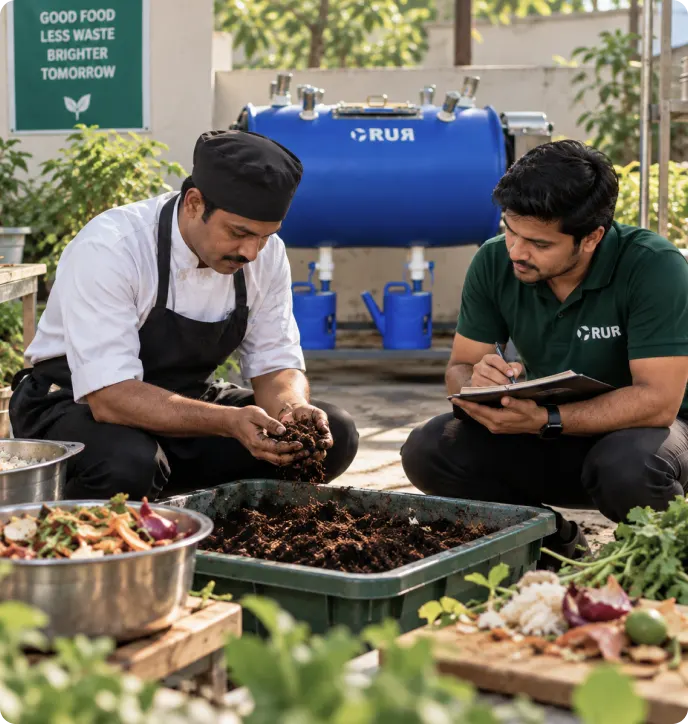
The science gives you the process. The art is knowing how to make that process work in a real kitchen.
RUR systems are designed around proven composting principles, appropriate processing conditions and practical waste volumes.
Every kitchen is different.
Cuisine, menu, staff habits, waste patterns, space, seasonality and operating routines all influence how a composting system performs.
That’s why we don’t start with a machine. We start by understanding the kitchen.
The right composting solution depends on your waste, workflow, space and operating conditions. Our advisors assess your kitchen first, then recommend the right approach—remotely or on-site, depending on your needs.
KWAN covers six core areas for anyone managing or planning kitchen waste: Kitchen Waste Basics, which explains the fundamental categories and vocabulary of kitchen waste; All About Composting, which explains how the composting process itself works; Waste Segregation, which covers the practical habits that make composting succeed; Solid Waste Management Rules, which explains the current regulatory requirements in plain language; India Composting Overview, which situates a kitchen’s own composting decision within the national picture; and a Composting ROI Calculator, which lets a kitchen estimate its own savings and payback period. Together these give a commercial kitchen everything it needs to plan a composting decision with confidence, before ever discussing equipment.
No. The ROI calculator only needs two inputs, your kitchen’s approximate daily waste volume and your current monthly disposal cost, to estimate your payback period, monthly savings, and annual compost output. The Kitchen Waste Basics and All About Composting sections are there if you want to understand the process itself, but they are not required to get a useful estimate from the calculator.
KWAN is built specifically around commercial kitchen waste in the Indian regulatory and operational context, rather than generic composting information. The Solid Waste Management Rules section reflects the current 2026 rules and real enforcement developments, not outdated regulations. The composting explanation is built around RUR’s own patented aerobic process, not a generic method. And KWAN connects directly to a real assessment and advisory pathway, so a kitchen that wants to move from reading to planning can do so on the same page, through a segregation workshop, a waste risk assessment, or a direct conversation with an advisor.
KWAN is the broader knowledge hub covering waste basics, the composting process, segregation, regulations, national context, and the ROI calculator, all in one place for anyone planning a kitchen waste decision. The Compliance Hub is a more detailed, dedicated resource focused specifically on the Solid Waste Management Rules 2026, including a bulk waste generator self-check and current enforcement examples. The Solid Waste Management Rules section within KWAN gives a summary and links through to the full Compliance Hub for anyone who wants the complete regulatory picture.
No. KWAN’s content and calculator are designed to help you understand your own kitchen’s waste and options, with no obligation to purchase anything. Many kitchens use the ROI calculator or read through the compliance information simply to understand their position. If and when a composting system makes sense for your kitchen, KWAN can recommend the right one for your volume and space, but the choice and the timing are always yours.